UPDATES
FROM OUR NETWORK
PUBLIC NOTICE OF AGM 2025
Notification of the Annual General Meeting of Business Victor Harbor.24th September 2025
Showcase Your Products in Parliament House gift shop in Canberra
The Local Jobs, Local People grant opportunity, delivered under the Local Jobs Program, will fund activities addressing local employment needs, supporting individuals into ongoing employment, or providing a clear pathway to employment. Supporting people registered in employment services is a priority.The grant opportunity will provide a total of up to $10 million (GST exclusive) in funding to 30 June 2027. The grant round will be conducted through an open competitive process. It is anticipated the grants will be from around $50,000 to $250,000 (GST exclusive).Grants awarded under this opportunity will support activities addressing one or more of the priorities in the Local Jobs Plan for each relevant Employment Region. Successful grants will focus on supporting those who experience barriers to employment, such as First Nations peoples, mature age Australians, migrants and refugees or young people, or focus on opportunities for local employment in critical sectors such as construction, manufacturing, care and support, digital and emerging technologies, and the energy transition.
Grant Opportunity
The Local Jobs, Local People grant opportunity, delivered under the Local Jobs Program, will fund activities addressing local employment needs, supporting individuals into ongoing employment, or providing a clear pathway to employment. Supporting people registered in employment services is a priority.The grant opportunity will provide a total of up to $10 million (GST exclusive) in funding to 30 June 2027. The grant round will be conducted through an open competitive process. It is anticipated the grants will be from around $50,000 to $250,000 (GST exclusive).Grants awarded under this opportunity will support activities addressing one or more of the priorities in the Local Jobs Plan for each relevant Employment Region. Successful grants will focus on supporting those who experience barriers to employment, such as First Nations peoples, mature age Australians, migrants and refugees or young people, or focus on opportunities for local employment in critical sectors such as construction, manufacturing, care and support, digital and emerging technologies, and the energy transition.
Algal Bloom Media Release
MEDIA RELEASEFOR IMMEDIATE RELEASEAlgal Bloom Support Fails Local BusinessesVictor Harbor Chamber slams delayed response and flawed grant program, says businessconfidence, certainty and trade has been lost!Business Victor Harbor (BVH) has rebuked the State Government’s response to the harmfulalgal bloom crisis as “delayed and deeply inadequate,” warning that the economic damageto local trade and tourism has already been done — and won’t be reversed by late-stageadvertising or narrow grant schemes.
Algal Bloom Small Business Support Grant
URGENT & IMPORTANT: Small business grants available for eligible small businesses effected by the Algal Bloom across the Fleurieu CoastThe Algal Bloom Small Business Support Grant is designed to support small businesses and not-for-profit organisations that fit into the following categories:• marine or coastal tourism operator* (excluding hospitality and food services)• charter boat and fishing charter operator• marine-based sport and/or school (e.g. surf school)• commercial fisheries and aquaculture licence holder• seafood processor• marine and fishing supply chain manufacturer or retailer (e.g. tackle shops, marine equipment suppliers)• marine or coastal caravan parks, camping grounds and other accommodation providers (excluding short-term private/holiday rental providers, e.g. private properties rented through real estate agents or booking sites such as Airbnb or Stayz).• beachfront kiosk/cafes*.(*) Must be listed on the Australian Tourism Data Warehouse as at the date of application.To apply for this grant kindly go to the following link:https://business.sa.gov.au/algal-bloom/small-business-support-grant
2025 Excellence in Business Awards
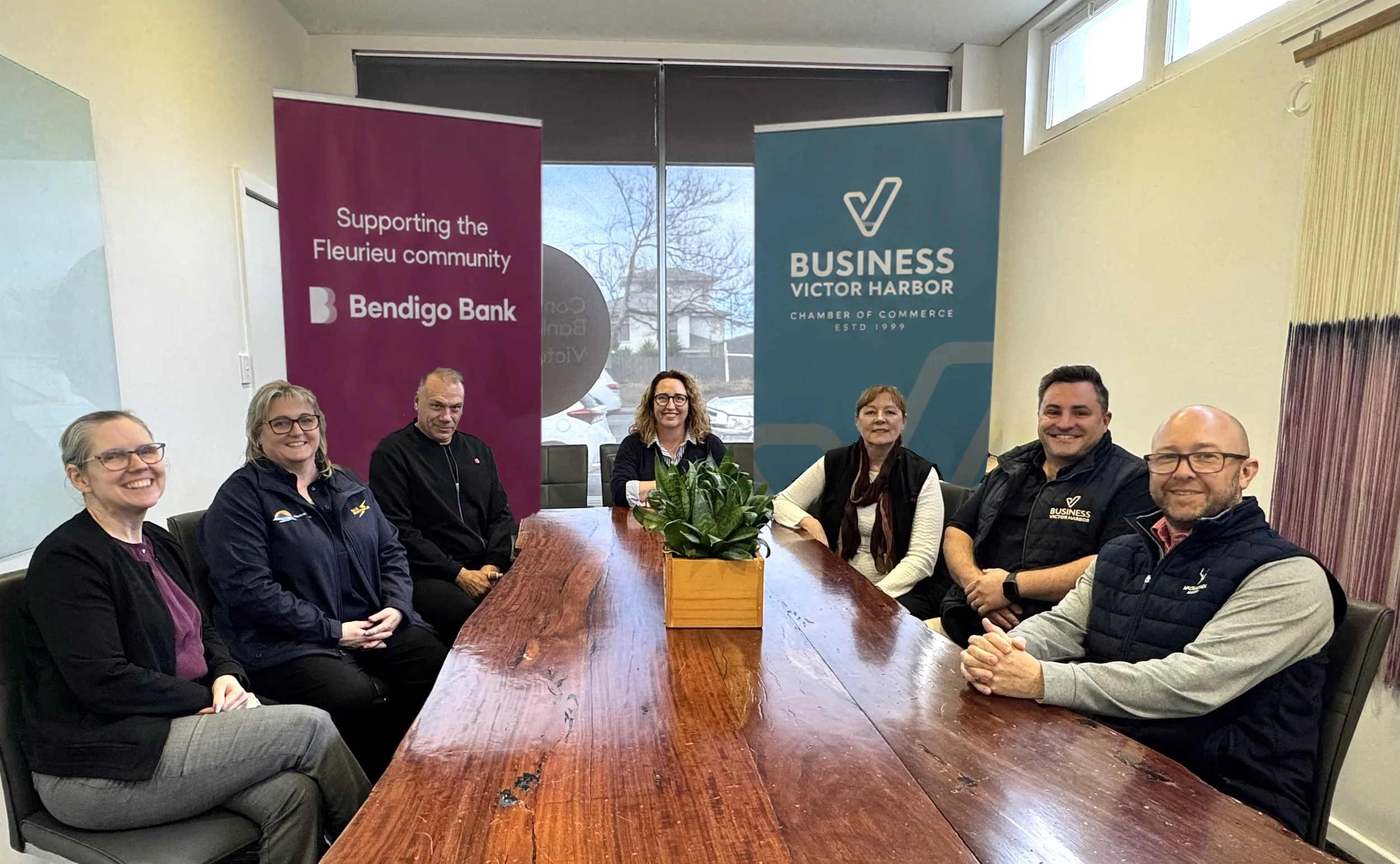
OFFICIAL ANNOUNCEMENTWe’re thrilled to announce the date for the 2025 Excellence in Business Awards, proudly presented by Business Victor Harbor and made possible thanks to the generous support of our Major Partner– Community Bank Fleurieu Bendigo Bank.This prestigious black tie event celebrates the innovation, resilience, and success of the Fleurieu' s business community – and we want YOU to be there to witness and be part of it!Lock it into your calendar now and stay tuned for more exciting details on how to nominate your business for an award. It’s a night not to be missed.Friday 5th December 2025McCracken Convention CentreNominations Open Soon
Victor Harbor Urban Growth Management Strategy - Open for Consultation
In October 2024, the draft City of Victor Harbor Urban Growth Management Strategy was released for community feedback. Following this feedback, Council has made multiple improvements to the Strategy to ensure that our city remains a place of choice to live, work, invest and visit for our current and future community.Before we finalise the Strategy, we would like to hear your feedback on these improvements. An updated draft Urban Growth Management Strategy has been released for a final round of community consultation.A summary of what we heard from the community during the last round of consultation and the key changes made to the updated Strategy are provided on Council’s Your Say Victor Harbor website or can be viewed in hard copy at the Civic Centre (1 Bay Road, Victor Harbor).You can have your say by:• Attending a Community Open Day Session held at the Civic Centre on 1 Bay Road, Victor Harbor on:o Saturday, 28 June 2025 between 9.30am and 12.30pmo Tuesday, 1 July 2025 between 3pm and 6pmPlease register your attendance here: bit.ly/UGMS-Open-Days-Registration• Completing a survey before 5pm on Thursday, 10 July 2025 either via:o Online at www.yoursay.victor.sa.gov.au/ugmso Hard copies available from the Civic Centre at 1 Bay Road, Victor Harbor• Making a written submission and return it before 5pm on Thursday, 10 July 2025 either via:o the online submission formo email to localgov@victor.sa.gov.auo post to City of Victor Harbor (UGMS Consultation), PO Box 11, Victor Harbor SA 5211oMore information?A copy of the draft Urban Growth Management Strategy and supporting documents are available online or a hard copy can be collected from the City of Victor Harbor Civic Centre (1 Bay Road, Victor Harbor).
Host a Work Experience Placement – Expression of Interest Now Open
Grow Your Business. Inspire a Student.Host a Work Experience Placement – Expression of Interest Now OpenBusiness Victor Harbor is inviting local business owners to express their interest in hosting a high school student for work experience. This is a chance to give back to the community, contribute to future workforce development, and potentially discover your next team member.________________________________________Why Get Involved?✓ Support Local Youth – Help students explore real career pathways✓ Build a Talent Pipeline – Identify potential future apprentices or staff✓ Give Back – Share your knowledge and mentor the next generation✓ Fresh Perspectives – Gain new insights from motivated young people________________________________________What’s Involved?• You decide the tasks or shadowing opportunities• Students are supervised at all times• No payment is required – this is not employment• Work Health & Safety and insurance are handled in partnership with the schools• You set the placement timing and capacity that works for your business________________________________________How to Express InterestWe’re currently gathering expressions of interest from local businesses.This is not a commitment – just a signal that you’re open to considering student placements in the future.With your permission, Business Victor Harbor will pass your details to:• Victor Harbor High School• Investigator College• Encounter Lutheran CollegeAll placement arrangements will be handled directly between the school and your business.📅 Submit your interest by: Friday 13th June 2025🔗 Register here: members@businessvictorharbor.com.au________________________________________ℹ️ Want to Know More?Visit https://www.education.sa.gov.au/schools-and-educators/curriculum-and-teaching/curriculum-programs/workplace-learning-work-placement-and-work-experienceReach out to BVH📧 members@businessvictorharbor.com.au📞 0436 677 188🌐 www.businessvictorharbor.com.au________________________________________Let’s invest in our region’s future – one student, one business, one opportunity at a time.
Council's Farm Business Support Grant
The City of Victor Harbor has launched a new Farm Business Support Grant Program to assist local Agribusinesses.At a Special Council Meeting on Monday, 7 April 2025 the City of Victor Harbor took steps to support its local farm businesses through a new Farm Business Support Grant Program.The new grant program aims to provide much-needed assistance to local agribusinesses facing challenges due to current dry weather conditions.The program aims to help farm businesses within the City of Victor Harbor council area maintain operations during this challenging time by providing funding to cover essential and unavoidable business expenses.The program, which officially launched on Monday, 14 April 2025, provides an $80,000 funding pool through which eligible applicants the opportunity to apply for up to $2,500 (ex GST) to support costs of:* Power bills for water pumping for livestock* Water, feed, fodder and other farm supplies* Freight expenses for water or feed.Applications will be assessed on an ongoing basis and can be lodged from Monday 14 April 2025. Applications close on Friday 30 May 2025 or until the budget is fully exhausted.
Cut Waste, Boost Profits: Fleurieu Food Waste Survey
Cut Waste, Boost Profits: Fleurieu Food Waste SurveyAre you a food business in the Greater Fleurieu region?Reducing food waste isn’t just good for the environment — it’s good for business. For every $1 invested in food waste reduction, businesses save around $14 in operating costs.We’re inviting local food businesses to complete a short survey to help us build a clear picture of current practices and identify practical, cost-saving opportunities across the region.Your insights will inform targeted solutions and future support for businesses like yours. All responses are confidential. Aggregated results will be shared at the Fleurieu Food Waste Forum on Monday 23 June 2025. Event details will follow from Business Victor Harbor, and we encourage all food businesses to attend.Complete the survey by Thursday 1 May 2025 to support this important work – and go into the weekly draw to win a $100 Prezzee gift card, redeemable at hundreds of retailers.One winner will be drawn each Friday from 11 April to 2 May 2025. To be eligible, you must operate a food business in the Greater Fleurieu region, complete the survey, and provide your contact details. Winners will be notified by email. Gift cards are subject to Prezzee’s terms and conditions.
AIM Business Sustainability Grants Now Open
Green Industries SA’s Assess-Implement-Monitor (AIM) grants are now open.Applications may be submitted anytime until the closing date, 16 May 2025.AIM grants provide a contribution of up to $15,000 towards the cost of expert advisory services to complete an assessment that establishes or builds upon baseline data, analyses, assesses, and reports on current practice, identifies and prioritises opportunities for improvements and builds the business case for investment in one or more of the following areas:• Implementation of circular economy principles and practices/adoption of circular business models• Materials efficiency and better practice waste management• Better practice waste management coupled with energy, water, trade waste, and/or emissions management improvements• Scope 3 emissions management and reduction – may be coupled with an assessment of scope 1 and 2 emissions, and/or development of net zero strategieso Must include assessment and improvement recommendations related to waste management and purchased good and services, with consideration of downstream use, processing and end-of-life treatment of goods/products, and opportunities to incorporate more circular business practices.
2025-2026 Federal Budget
News2025-2026 Federal BudgetMajor infrastructure funding in the 2025 Federal Budget will enhance road safety and freight productivity in our region. To read more https://rdahc.com.au/2025-2026-federal-budget/
BVH Policy Statement 2025 2026
POLICY STATEMENT 2025 - 2026Business Victor Harbor (BVH) functions as an independent chamber of commerce, working closely with local businesses, business groups, the City of Victor Harbor, neighbouring councils, industry associations, government bodies, and key industry organisations. Our mission is to lead initiatives that drive economic development, fostering a thriving, resilient, and dynamic business environment.BVH's strategic direction focuses on unifying efforts to attract, grow, and retain businesses. We advocate for local operational interests and cultivate a collaborative environment to support business growth and sustainability.As a business chamber, BVH is a powerful advocate for the business community. We diligently represent our members' interests, serving as their collective voice in dialogues with local, regional, and national government entities. Our advocacy and policy initiatives aim to create a favourable regional business climate, address regulatory challenges, and promote economic advancement.At the core of BVH’s strategic vision is the recognition of Victor Harbor as the business heart of the greaterFleurieu region.From an economic perspective, this Policy Statement supports, advocates, and represents the greater Fleurieu region, that covers the LGA areas of Victor Harbor, Alexandrina, Yankalilla, Kangaroo Island and the southern part of Onkaparinga.The Fleurieu region proudly offers a unique 'paddock to plate' experience, encompassing wine, tourism, and exceptional liveability. Additionally, the region provides 'cradle to grave' services—from childcare to aged care—setting it apart from most other South Australian regions.The following data, as of December 2022, illustrates the economic impacts of businesses across the greater Fleurieu region encompassing the LGAs of City of Victor Harbor, District Council of Yankalilla, Kangaroo Island, and Alexandrina Council:• Economic Output: $5.1Bi• Employment: 17,029 peopleii• Largest industry sector for economic input: Agriculture, Forestry & Fishing at $873.7M• Largest industry employer: Health Care & Social Assistance with 2,752 jobs• Wages paid to employees: $1.1B - Health Care & Social Assistance industry pays the most in wages and salaries at $247M iii• Exports: $1.2B - Agriculture, Forestry & Fishing industry contributes the most for regional exports at$490Miv• Imports: $1.1B - Manufacturing industry spends the most on regional imports at $234Mv• Value Added: $2.5B Regional Imports - Rental, Hiring & Real Estate Services industry is the largest value-added contributor at $455.5Mvi• Gross Regional Product (GRP): $2.087Bviio $1.280 billion is contributed by Alexandrina LGAo $806.957 million is contributed by Victor Harbor LGAo $290.109 million is contributed by Yankalilla LGAo $361.639 million is contributed by Kangaroo Island LGA• Population circa 2023/24o 30,000 Alexandrina LGAo 16,100 Victor Harbor LGAo 5,800Yankalilla LGAo 4,900 Kangaroo Island LGAChallenges impacting business growth and confidenceBusiness growth and confidence across the region are being impacted by several challenges, including limited access to accommodation, housing affordability issues, rising living costs, employment shortages, a lack of suitably qualified staff, reduced discretionary spending, stagnant wages, and high household debt.Operating costs are rising amidst flat to buoyant sales, squeezing business margins. Increased expenses in rent, utilities, Council rates, product and service supplies, fuel, wages, payroll tax, superannuation, industrial relations, WHS practices, regulatory requirements, and national wage rises are putting significant pressure on locally owned businesses.South Australia faces exceedingly high energy costs, with non-contestable energy expenses making up to 47% of energy bills due to infrastructure supply and maintenance. These high costs severely impact local business communities and overall confidence.Additionally, the government's ban on single-use plastic products is creating supply, sales, and transition challenges for many businesses in the region. BVH is actively championing collaborative efforts and projects to support the business community in adapting to plastic reductions and promoting environmental sustainability, including initiatives in the circular economy.BVH’s 2024/2026 Policy Statement is prioritised under the following 5 key categories:1. Regulatory2. Environmental Sustainability3. Doing Business - Challenges4. Industrial Relations5. Regional ‘Driven & Grown’“BVH mandates non-negotiable local community consultation for all future developments and calls on governments to prioritise planning and infrastructure frameworks, ensuring local representation and automatic inclusion of local businesses in development consultations”“BVH urges Local and State Governments to conduct strategic and community benefit analyses of current infrastructure (including access to a robust local public transport system), ensuring active involvement and consultation of local community and business representatives in future infrastructure planning”“BVH calls for a review of the WHS system to simplify compliance and increase flexibility for all South Australian industry sectors”“BVH believes the Single-use and Other Plastic Products (Waste Avoidance) Bill 2020 requires close monitoring and attention”“We urge the Government to provide ongoing support for recycling and environmental sustainability, as these have significant impacts on current business models”“BVH calls for a review of Waste Levy costs”“BVH urges the SA Government to support regional business owners by taking action to reduce both contestable and non-contestable power costs and improve reliability”“BVH believes that reducing the costs of doing business, including increasing the Payroll Tax threshold from $1.5m to $3m is essential in stimulating business confidence, create employment opportunities, encourage more sustainable reinvestment and growth in the region's local economy”“BVH urgently seeks a review of the RTWSA scheme’s 2-year claim period and its impact on insurance claims against businesses”“BVH believes training funding should be linked to career development, employment, and up-skilling; seeks SA Government consideration of Payroll Tax/RTWSA reductions forbusinesses hiring trainees or apprentices; requests support for an 'Employer’s Guarantee' post-training; and advocates for establishing vocational education structures for regional, industry-specific training programs”“BVH urges the State Government to lobby federally for a review of industrial relations, focusing on simplifying the complexities of awards and their impact on SA businesses. BVH believes that Local and State Governments should prioritise policies that drive local production and manufacturing of goods and services within the region”POLICY 1 RegulatoryISSUE/RATIONALE1. PLANNINGBVH mandates non-negotiable local community consultation for all future developments and calls on governments to prioritise planning and infrastructure frameworks, ensuring local representation and automatic inclusion of local businesses in development consultations.BVH urges State Government to recognise the Greater Fleurieu as a regional SA identity, with Victor Harbor as the ‘heart’ of this region and not be swept up as part of the Greater Area of Adelaide.2. INFRASTRUCTUREBVH urges Local and State Governments to conduct strategic and community benefit analysis of current infrastructure, ensuring active involvement and consultation of local community and business representatives in future infrastructure planning, including public transport access, impacting local businesses.BVH has observed that certain development applications have led to downturns in main street businesses and the splitting of business districts, particularly in town centres like Victor Harbor. For example, the opening of the Victor Central Business precinct and the Bunnings/Aldi Hayborough development caused significant declines in traffic and closures in Victor Harbor’s CBD.Across South Australia’s regional districts, 'out of centre' retail developments have often gutted main streets, draining the community shopping areas of their vitality. Examples include Mt Gambier, Renmark, Port Augusta, and Whyalla. These developments simply shift retail traffic away from main streets, leading to business closures unless there is a substantial population increase.BVH recommends adopting a performance-based approach for any proposed 'out of centre' business development. Such developments must unequivocally demonstrate no detrimental impact on existing business centres.While BVH supports development that clearly benefits economic and community prosperity, any major development impacting businesses must include robust community consultation.Over the past three decades in South Australia, industrial and rural lands have often been re- zoned to residential or commercial with little or no consultation, leading to negative consequences for businesses, communities, and infrastructure. Examples include Buckland Park and Riverlea Estate, with inadequate infrastructure e.g. access roads, sewer, water, etc.There are several developments planned for the region with some already underway including the areas of Victor Harbor, Goolwa and Strathalbyn and BVH’s business community does not want to witness those planning and development challenges being experienced in Mt Barker.Any new proposed business or retail centre, especially 'out of centre' developments, must include a comprehensive retail/business catchment analysis and a 'net community benefit test.' A consistent and transparent 'Sequential Test' should be applied, based on:- Strategic fit- Net community benefit- Place and infrastructure qualityBVH believes that the region’s infrastructure planning must support and address the future needs of a thriving community and a strong, growing business sector, including the supply chains throughout the region.Businesses and their supply chains need fewer impediments to delivering, servicing, and moving goods and products across the region.BVH acknowledges that freight costs within the region are at a premium for local businesses. Rising costs are exacerbated by the poor condition of freight corridors and road networks, especially between major towns and south of the line from Myponga/Willunga to Strathalbyn.The growth of the Fleurieu region’s southern coastal communities is straining infrastructure, including public transport access, impacting both businesses and the community’s ability to travel and access services.3. NATIONAL & STATE WHS REVIEWBVH calls for a review of the WHS system to simplify compliance and increase flexibility for all South Australian industry sectors.4. SINGLE -USE PLASTIC; ENVIRONMENTAL WASTE MANAGEMENT & CIRCULAR ECONOMYBVH believes the Single-use and Other Plastic Products (Waste Avoidance) Bill 2020 requires close monitoring and attention.We urge the Government to provide ongoing support for recycling and environmental sustainability, as these have significant impacts on current business models.BVH calls for a review of Waste Levy costs.5. ENERGYBVH urges the SA Government to support regional business owners by taking action to reduce both contestable and non-contestable power costs and improve reliability. Work Health & Safety compliance remains overly complex and prescriptive, adding significantcosts and placing unnecessary stress and potential litigation risks on business owners. BVH collaborates with SafeWorkSA to support business owners and members as needed.WHS legislative and regulatory information must be simplified and provided to regional businesses in an easily understood format, with improved education. Recent regulatory changes have impacted all businesses, including micro and home businesses.The reinforced and strengthened legislative requirements effective from 25 December 2023, which include training and mental health as part of psychological workplace compliance, highlight the importance of maintaining a healthy workforce. This is now a critical need for all business owners.2 Environmental SustainabilityState legislation has introduced significant changes and costs for food and beverage businesses, as well as other suppliers and manufacturers, with a critical focus on recycling and sustainability.The Single-use and Other Plastic Products (Waste Avoidance) Bill 2020, introduced on 30 April 2020, will have major effects on food and beverage businesses, with the second and third stage regulations taking effect in 2024 and 2025.BVH has raised concerns about the lack of clear messaging and guidance on upcoming transitions, which has led to confusion among business owners.BVH has actively participated in consultations on this matter, partnering with Green Industries SA and engaging in 'going circular' projects with LEAP grants.Effective transition to the prohibition of certain plastics requires clear communication and appropriate timeframes for business owners to adapt.Consistency in the approach of local government Environment Health Officers (EHOs) regarding banned plastic products is crucial, as EHOs, via the EPA, are responsible for business compliance.The waste levy is a significant cost to businesses and the broader community. BVH seeks a review of the levy to establish best practices and achieve optimal outcomes.3 Doing Business - ChallengesRegional business owners face significant ancillary charges on their electricity bills due to policy decisions involving the energy mix and interconnector base-loads. These non-contestable costs, passed on by energy retailers, are beyond the control of business owners.BVH believes SA's energy market and infrastructure remain vulnerable and unreliable.Ancillary charges can constitute up to 47% of total energy bills for some businesses. Reliable and affordable energy is essential for regional businesses, and losses from blackouts, infrastructure upgrades, and system unreliability are unacceptable and irrecoverable.6. AFFORDABLE HOUSING;ADDITIONAL CHILDCARE SERVICES; RENTAL ACCOMMODATION & PUBLIC TRANSPORT FOR WORKERSBVH is concerned with the lack of affordable housing; childcare facilities and high cost of rental accommodation, which stresses regional local employment availability and increases labour costs.BVH urges both State & Federal Governments to consider reviewing and/or increasing incentivisation programs that focus on regional child care facilities and housing building/accommodation and rental initiatives, including recognising all of the Greater Fleurieu as regional SA7. COSTS & IMPEDIMENTS OF DOINGBUSINESSBVH believes that reducing the costs and impediments of doing business is essential to stimulate business confidence, create employment opportunities, and encourage reinvestment in the region's local economy.BVH seeks Govt to consider the current Payroll Tax threshold be lifted from $1.5m to $3m8. RETURN TO WORK (WORKCOVER)BVH urgently seeks a review of the RTWSA scheme’s 2-year claim period and its impact on insurance claims against businesses.Regional businesses are challenged with the impacts of sourcing labour due to the lack of affordable housing, lack of childcare facilities and little or no public transport for workers travel.Businesses accessing labour, together with potential staff being able to access affordable housing/rental accommodation, child care and travel to work, directly impacts the local & broader employment market and availability, increasing considerable costs to a business’s bottom line, whilst also increasing the costs of local products, services and supply.Understanding that all regional SA economies are experiencing unprecedented high costs of living and doing business, both State & Federal governments must be able to facilitate programs and incentivisation initiatives that inspire and energise both community and local business growth.Whilst Victor Harbor, including its surrounding regions that make up the Greater Fleurieu boast tremendous tourism, agri-tourism, paddock-to-plate destinations and the place to visit, live, work, play and enjoy a wonderful lifestyle, local businesses and their supply chains that deliver the intricate eco-system from cradle-to-grave must be supported recognising the unique differentiation to metro-Adelaide.Affordable housing and rental accommodation, plus child care facilities and reasonable public transport for workers is now more than ever at a crisis point for the region, which stifles our local businesses growth and the ‘knock-on’ effect as a ‘liveable’ destination is now at a major cross-road.The cost of doing business in South Australia has been continually increasing. State taxes and changes remain too high and need reduction. Payroll tax has risen due to national wage increases, necessitating higher thresholds or lower rates.Payroll tax has been increasing due to national wages increases and the threshold levels need to be lifted or rates decreased. BVH advocates for the current minimum $1.5m annual wages threshold to be lifted to $3m. Annual National Minimum Wages Rates have increased by 17.2% over the past 4 years.Implications of increasing SA Water costs due to water augmentation charges from 1st July 2024 will increase by 3.5%pa, including developers having to pay from $2.5k for infill developments to increase to $10k by 2027-28.With many businesses already under stress due to continual increased costs of doing business and the current ‘cost of living’ having impacts across the region, it is expected that small/medium sized businesses will be forced to save costs or close.Under the current Return to Work scheme, businesses face potential claims against their Business Liability insurance for workplace injuries exceeding two years, once employees exit the scheme. After the two-year period, employees are supposed to find work or transition to Federal Government support schemes. However, a trend has emerged where employees, after two years in the scheme, lodge litigation against employers for loss of income or earning capacity, driving up business insurance costs.BVH urgently seeks a review of the impact of this behaviour on the Return to Work scheme, insurance offerings, and the business community.9. FUNDING FOR TRAININGBVH believes training funding should be linked to career development, employment, and up-skilling; seeks SA Government consideration of Payroll Tax/RTWSA exemptions for businesses hiring trainees or apprentices; requests support for an 'Employer’s Guarantee' post-training; and advocates for establishing vocational education structures for regional, industry-specific training programs.10. INDUSTRIAL RELATIONS IMPACTING ON SA BUSINESSESTraining and skills investment are critical to business operations and must target job participation, improve skills and capabilities, and be delivered locally to strengthen career pathways. Note: There are currently significant skills shortages in retail & hospitality.BVH strongly advocates for employer-incentivised industry-based traineeships and apprenticeships. These are essential for creating new jobs, up-skilling, and developing trades from entry-level to management, meeting local industry demands.BVH recognises the current demand in health services (including childcare to aged care), professional services, construction, and the visitor economy (tourism, hospitality, and retail). Additionally, skills and training programs in the 'paddock-to-plate' agriculture industry are in high demand.BVH seeks the delivery of industry-specific training regionally to save operational costs and support local reinvestment. We encourage collaborative regional training delivery models through public (TAFE) and private (RTOs) partnerships, ensuring local trainees and apprentices receive all training locally.BVH believes government policy should lead training programs matched to local job demand and supply, proposing to re-instate Employers Incentive Schemes for retail/hospitality and consideration of an ‘Employers Guarantee’ for at least 12 months of employment post-training. This initiative will strengthen the screening of training candidates and improve completion rates.Training should include rapidly changing technologies, WHS safe workplace environments, healthy workers, mental health programs, business management, cyber security, technology skills, waste management, recycling, and environmental sustainability.BVH advocates for the development and implementation of an industry-led Fleurieu Regional Workforce Development Plan.4 Industrial RelationsBVH urges the State Government to lobby federally for a review of industrial relations, focusing on simplifying the complexities of awards and their impact on SA businesses.Over the past decade, numerous allegations of underpayment of wages have been reported.Businesses often cite the complexities of award systems as a significant contributor to unintended errors in employee payments.Owners strive to pay staff correctly, but the intricate regulations often lead to unintentional mistakes.Beyond wages, businesses face increasing industrial relations challenges, including evolving compliance requirements that particularly burden small businesses with additional red tape.The industrial system is overly complex for business owners and requires radical simplification to achieve the best outcomes for both employers and employees.A simpler, user-friendly award system benefits all parties.11. SA REGIONAL MANUFACTURING, PRODUCTION & SERVICESBVH believes that Local and State Governments should prioritise policies that drive local production & manufacturing of goods and services within the region. 5 Local ‘Driven & Grown Business’The COVID experience highlighted the critical need for self-reliance on local goods for South Australian consumers.Fostering local supply chains and services attracts investment, enhances regional procurement, sovereignty of the region and stimulates growth.A focus on South Australian manufacturing and regional capabilities is essential.This requires a long-term plan to boost competitiveness through cheaper energy, skilled labour, training, lower taxes, and improved infrastructure.BVH supports ‘buy local’ initiatives, including Brand SA, and advocates for strategic messagingand marketing to attract, invest in, and retain regional business opportunities.Footnotesi Economic Output Data Overview: The output data represents the gross revenue generated by businesses in each industry sector within a defined region, also known as total sales or total income. Sources: ABS 2021 Census Place of Work Employment (Scaled), ABS 2021/2022 National Input Output Tables, and ABS June 2023 Gross State Product.ii Employment Data Overview (including Largest industry employer and industry sector by input) : The employment data shows the number of people employed in various industry sectors across defined regions, using place of work data without converting to full-time equivalents, and includes full-time, part-time, and casual positions. Sources: ABS 2021 Census Place of Work Employment (Scaled), ABS 2021/2022 National Input Output Tables, and ABS June 2023 Gross State Product.iii Wages & Salaries: includes all entitlements earned by employees from employers for services rendered, covering cash, in-kind benefits (e.g., food, accommodation, motor vehicles), and employer social contributions like superannuation and workers' compensation. Sources: Australian Bureau of Statistics Cat. 5209.0.55.001, ABS 2021 Census Place of Work Employment (Scaled), ABS 2021/2022 National Input Output Tables, and ABS June 2023 Gross State Product.iv Regional exports data: represents the value of goods and services generated by businesses within the region and sold outside it, bringing money into the region. This includes both domestic and international exports. For example, motels earning from visitors outside the region count as exports. Sources: ABS 2021 Census Place of Work Employment (Scaled), ABS 2021/2022 National Input Output Tables, and ABS June 2023 Gross State Product.v Regional imports data: represents the value of goods and services brought into the region by local businesses, resulting in an outflow of money. This includes both domestic and international imports, such as a local business outsourcing accountancy services to another region. Sources: ABS 2021 Census Place of Work Employment (Scaled), ABS 2021/2022 National Input Output Tables, and ABS June 2023 Gross State Product.vi Value-added: data represents the additional economic value generated by each industry sector in a region. It is calculated by subtracting local and regional import expenditures from the industry's output or by adding wages and salaries, gross operating surplus, and taxes on products and production. This data is crucial for calculating Gross Regional Product. Sources: ABS 2021 Census Place of Work Employment (Scaled), ABS 2021/2022 National Input Output Tables, and ABS June 2023 Gross State Product.vii Gross Regional Product (GRP) measures the net wealth generated by a region. It can be calculated using the incomes approach, which adds all incomes earned by individuals, firms, and governments, or the expenditure approach, which sums all final expenditures, excluding intermediate expenditures to avoid double counting. These methods align with those used for Gross State Product (GSP) and Gross Domestic Product (GDP). Sources: ABS 2021 Census Place of Work Employment (Scaled), ABS 2021/2022 National Input Output Tables, and ABS June 2023 Gross State Product.
Media Release SA Business Chamber Red tape out, yellowcake in, but business still feeling blue
Red tape out, yellowcake in, but business still feeling blueMedia release • SA Business Journal • South Australian Business News • ReportsTuesday, February 25th 2025MEDIA RELEASEThe findings of the latest South Australian Business Chamber — William Buck Survey of Business Expectations make interesting reading in the lead up to the federal election, with business operators speaking out on several key policy issues.The quarterly survey, now in its 44th year, checked in on confidence and conditions and the issues most impacting business; while also asking what government could do to help, and their views on the best source of energy for South Australia.No matter the size of the business, or the sector it operates in, the cost of doing business remains by far the most significant issue facing South Australian businesses. 75.1% of respondents named it as one of their top five issues.The next closest at 54.1% was profitability/profit margins, indicating that while managing cost pressures is an ongoing battle, a drop in revenue is compounding this issue.A close third at 50.5% was government policies, legislation and compliance which have grown in complexity following the introduction of major federal industrial relations changes. This number has been above 50% for the past three surveys, having been just 39.1% back in September 2023.South Australian Business Chamber CEO Andrew Kay said that costs continue to increase across the board. ‘Wages, energy, insurance, inputs, there isn’t a cost that hasn’t increased significantly over the past few years,” he said. “The Cost of Materials Index grew to its highest level since September 2023, while the Cost of Overheads Index also increased, marking the ninth consecutive quarter above 150 points.”“Unfortunately, these costs are not being passed on and the Average Selling Price Index has remained relatively flat over the last 18 months, leading to the reported squeeze on profits,” said Mr. Kay.Tellingly, when asked what is the one thing that government could do to make it easier to do business, a clear majority of respondents suggestions could be grouped as “reduce tax and red tape”. In the words of one small business operator “Australian business is drowning in unnecessary bureaucratic red tape and interference. Reduce tax. Reduce red and green tape.”Despite this, business felt a little bit brighter than in the previous quarter survey, with confidence up 7.5 points to 93.8. However, it should be noted that a score of 100% is the baseline, or neutral position, so businesses are still not feeling positive about their future.Recognising the pressure on power bills, this survey took the pulse of businesses on energy, and it generated a strong response. Mr. Kay said this did not come as a surprise.“We know from talking with our members, that energy can be quite an emotive subject,” said Mr. Kay. “The Chamber has taken a fuel-source agnostic view – we want energy that is cost effective, sustainable and consistent in its supply, while helping us meet our net zero targets – and we remain open-minded about how that is delivered. It seems that businesses share this approach.”“With more than 40% of businesses seeing their energy bills grow by 11 – 30% in the past year, it has become a critical part of their cost structure, and their views were clear,” he said.Solar, nuclear, gas, wind and hydrogen all received the tick of approval from more than 50% of businesses as an energy source. Solar led the way at 79.1% — unsurprisingly as 54.2% of businesses have installed panels – and nuclear energy came in second at 64.0%.The subject of the moratorium on nuclear energy was also raised, along with concerns or benefits businesses associated with nuclear as a power source.In the case of repealing the moratorium (66.5%) and the role of nuclear in the South Australian energy mix (65%), the respondents were approximately two thirds in favour.Businesses saw the benefits of nuclear outweighing their concerns, with dealing with nuclear waste and the initial establishment costs the only two concerns scoring greater than 50%, whereas seven potential benefits including less reliance on other states for power, investment and job creation and revenue for SA, all fared above the halfway mark.For a full copy of the December 2024 South Australian Business Chamber — William Buck Survey of Business Expectations go to https://sabusinesschamber.com.au/SOBE.For enquiries regarding this release, contact Andrew Kay,Chief Executive Officer at the South Australian Business Chamberakay@sabusinesschamber.com.au / 0439009590
Telstra Connected Communities Grant
In 2023 Telstra announced the Connected Communities Grant Program, supporting Australia’s remote, rural, and regional communities with $600,000 to foster inclusion and resilience over three years.Applications for 2025 Telstra Connected Communities Grant Program is now openIn partnership with the Foundation for Rural & Regional Renewal, grants of up to $10,000 are available to not-for-profits to help them build resilient, sustainable, and liveable communities.If you know of a community group or not-for-profit organisation that could use a hand – the Connected Communities Grant Program might be for them!The program has three themes:Resilient communities that are well prepared and socially connected, with the ability to renew and recover together when disaster strikes;Sustainable communities that are diverse and inclusive, through planning for the health, wellbeing and prosperity of their people and planet;Liveable communities that have digital capability, helping to equip people with the skills to live, learn and work in a digital society.Funds will be available for new or existing not-for-profit programs to help them scale their impact to help more Australians in rural and regional areas become better connected.Applications for the 2025 Telstra Connected Communities grant round will close at 5pm on Thursday 20th of March 2025. This round will make $200,000 available for applications of up to $10,000 each. Successful grants will be announced in June 2025 and successful applicants will have 12 months to complete funded projects.For more details on the Connected Communities Grant program https://www.telstra.com.au/exchange/telstra-connected-communities-grants
Main Street Reactivation
A huge THANK YOU to everyone sharing their vision for Victor Harbor’s main street.We’re buzzing with your ideas—pop-up bands & food stalls on Saturday afternoons (shoutout to Port Noarlunga!), a health food cafe next to The Joyful Path, a co-working space with a cafe, and even a secret date-night restaurant hidden behind a bookcase. And yes, more cafes? We hear you.You’ve made it clear—filling vacant buildings is key to bringing back the vibe. We would love to see property owners offer affordable leasing options to turn empty spaces into thriving hubs. This is just the beginning!Let’s keep the ideas flowing:💡 What excites you most—live music, quirky shops, or something else?📸 What’s your favourite main street memory you’d love to relive?🎯 CHALLENGE: Can you dream up a slogan for our revitalisation?Other towns have transformed quiet streets into bustling markets & art zones—let’s make Victor Harbor next! YOUR IDEAS ARE SHAPING THE FUTURE!Been to an epic main street elsewhere? Tell us what made it great! eo@businessvictorharbor.com.au